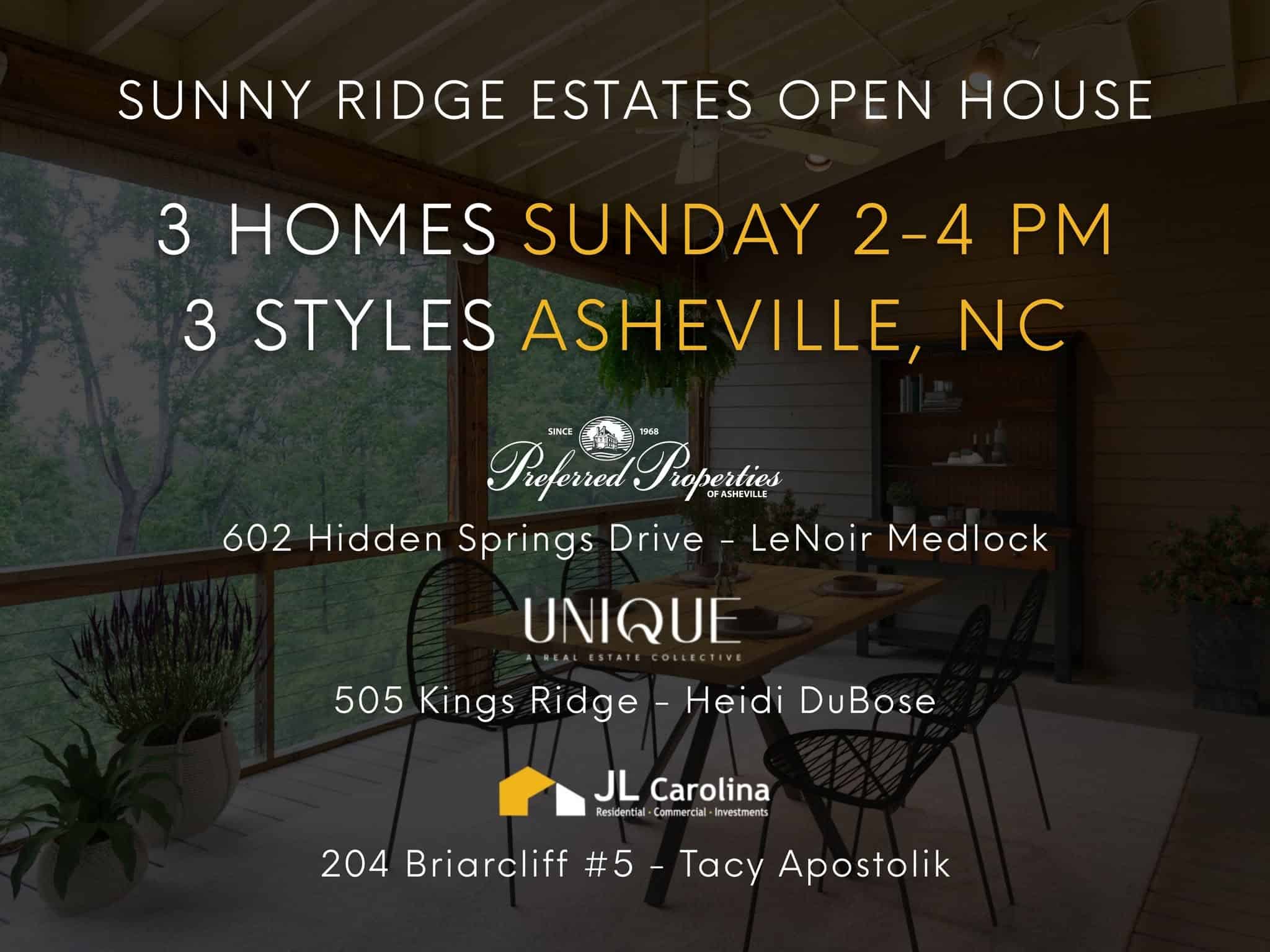
This Sunday! 3 Homes, 3 Styles, Sunny Ridge Estates 
 Sunday, September 20th
Open Houses are 2-4 PM
 602 Hidden Springs Drive - LeNoir Medlock
505 Kings Ridge - Heidi DuBose
204 Briarcliff #5 - Tacy Apostolik

This Sunday! 3 Homes, 3 Styles, Sunny Ridge Estates
Sunday, September 20th
Open Houses are 2-4 PM
602 Hidden Springs Drive - LeNoir Medlock
505 Kings Ridge - Heidi DuBose
204 Briarcliff #5 - Tacy Apostolik
Congratulations to our August 2026 Peak Performers! 🎉
We’re proud to celebrate the outstanding accomplishments of our top agents:
🏆 Top Producer – LeNoir Medlock, 828-691-9981
🏆 Top Listing Agent – Jim Reid, 828-606-0590
🏆 Top Buyer Agent – Sandy Lindsey, 828-230-5816
Your dedication and excellence continue to set the bar high! 👏
– Preferred Properties of Asheville –
🌐 preferredprop.com | 📞 828-258-2953
#PreferredPropertiesAVL #AshevilleRealEstate #TopAgents #RealEstateExcellence #peakperformers #topagents #WNCRealEstate #2026TopProducers #ListingAgent #BuyerAgent

.png)
.png)
Asheville Region Real Estate: 2025 vs. 2026
The market is moving but buyers and sellers may need a little more patience than they did a year ago.
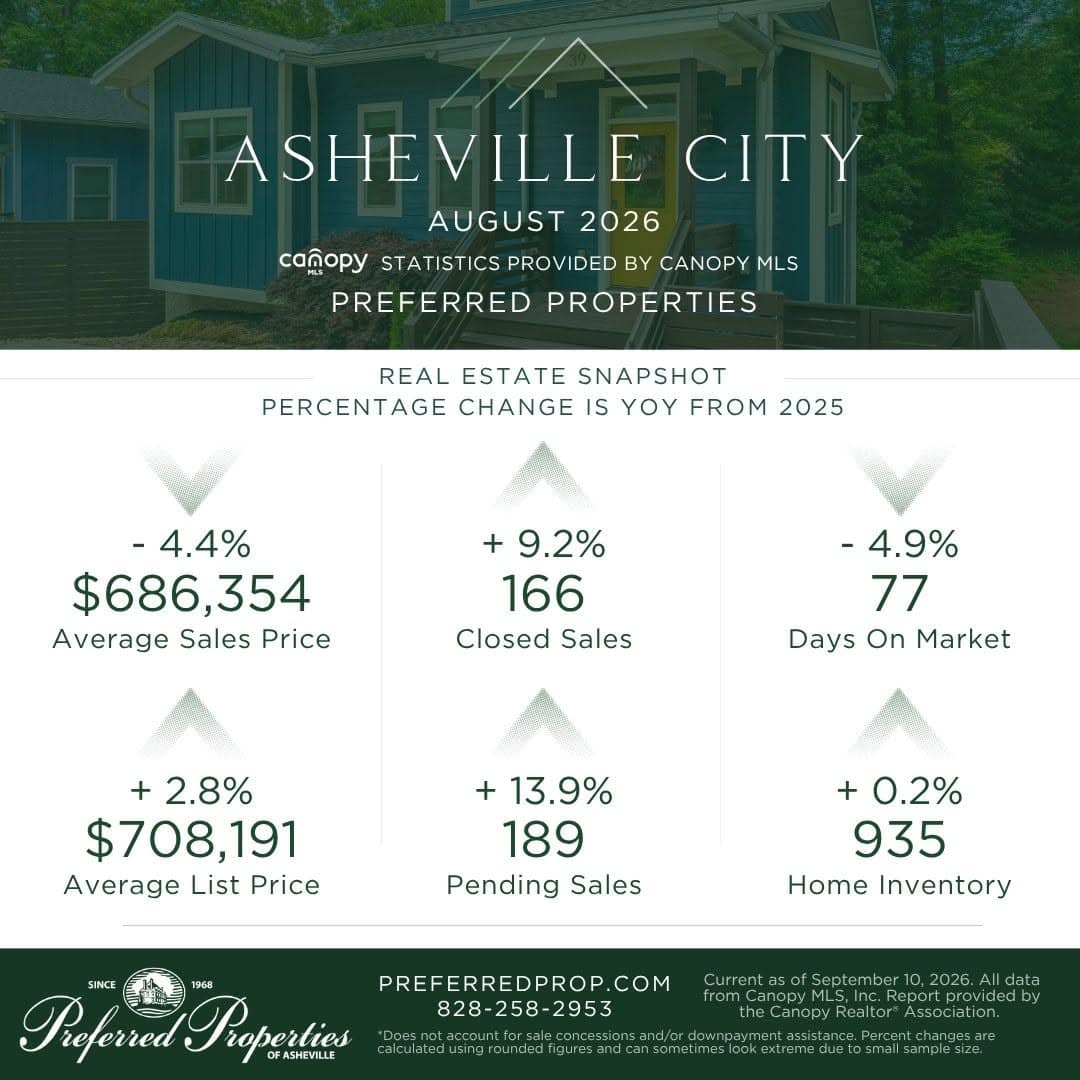
📍ASHEVILLE CITY — August 2026
More pending and closed sales, but median prices are lower.
Pending Sales: 189 | ⬆️+13.9%
Closed Sales: 166 | ⬆️+9.2%
Average Sales Price: $686,354 | ⬇️ -4.4%
Cumulative Days on Market Until Sale: 77 days | ⬇️ -4.9%
Average List Price: $708,191 | ⬆️+2.8%
Inventory of Homes for Sale: 935 | ⬆️+0.2%
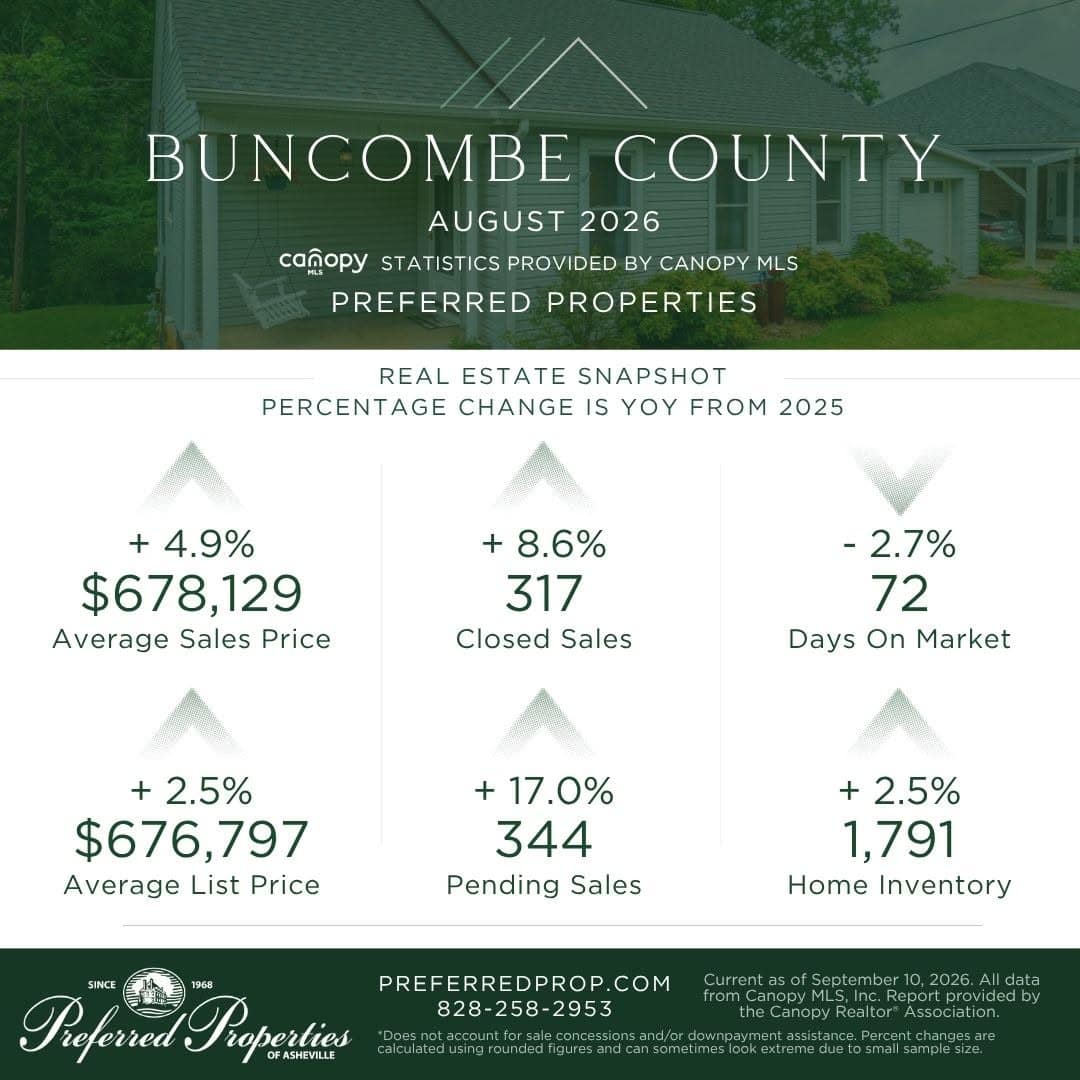
📍BUNCOMBE COUNTY — August 2026
Strong increase in pending and closed sales, with August prices higher than last year.
Pending Sales: 344 | ⬆️+17.0%
Closed Sales: 317 | ⬆️+8.6%
Average Sales Price: $678,129 | ⬆️+4.9%
Cumulative Days on Market Until Sale: 72 days | ⬇️ -2.7%
Average List Price: $676,797 | ⬇️ +2.5%
Inventory of Homes for Sale: 1,791 | ⬆️+2.5%
📍ASHEVILLE REGION — August 2026
More pending and closed activity YTD, but homes are taking longer to sell.
Includes Buncombe, Burke, Haywood, Henderson, Jackson, Madison, McDowell, Mitchell, Polk & Rutherford Counties.
Pending Sales: 1,005 | ⬆️+7.0%
Closed Sales: 869 | ⬇️-4.7%
Average Sales Price: $558,546 | ⬆️+0.2%
Cumulative Days on Market Until Sale: 77 days | ⬆️+8.5%
Average List Price: $596,418 | ⬆️0.0%
Inventory of Homes for Sale: 5,350 | ⬆️+2.7%
Preferred Properties of Asheville
828-258-2953
#AshevilleRealEstate #AshevilleNC #AshevilleHousingMarket #RealEstateMarket #AshevilleHomes #WesternNorthCarolina #HousingMarket
Takeaways: Homes are taking longer to sell and the average sales price has decreased. The July numbers point to a market with more inventory and a more time for buyers to make decisions, while sellers may need to pay close attention to pricing and market conditions. If you’re thinking about buying or selling, we’re happy to help you navigate the current market conditions.
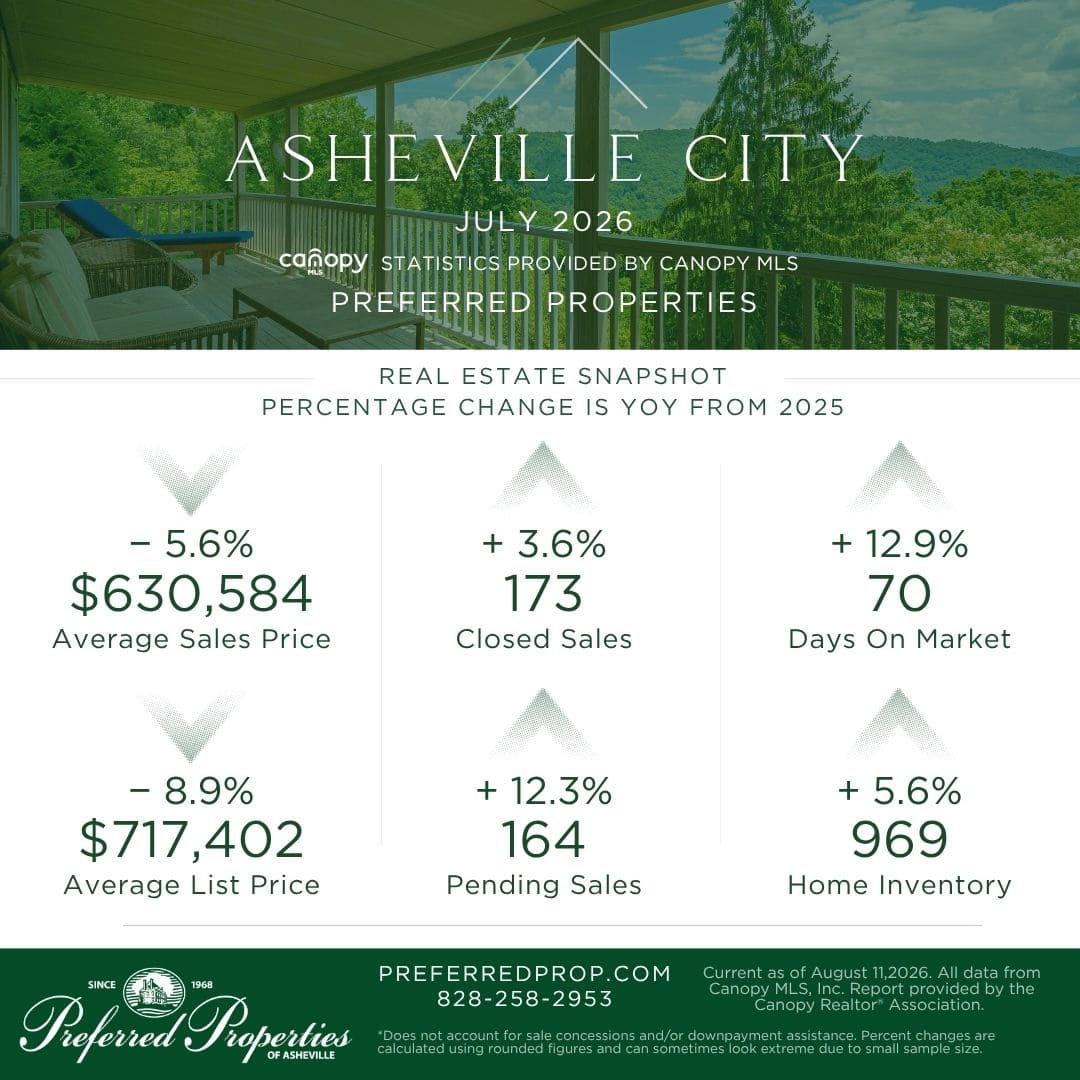
ASHEVILLE CITY — July 2026
Pending Sales: 164 | +12.3%
Closed Sales: 173 | +3.6%
Average Sales Price: $630,584 | −5.6%
Cumulative Days on Market Until Sale: 70 days | +12.9%
Average List Price: $717,402 | −8.9%
Inventory of Homes for Sale: 969 | +5.6%
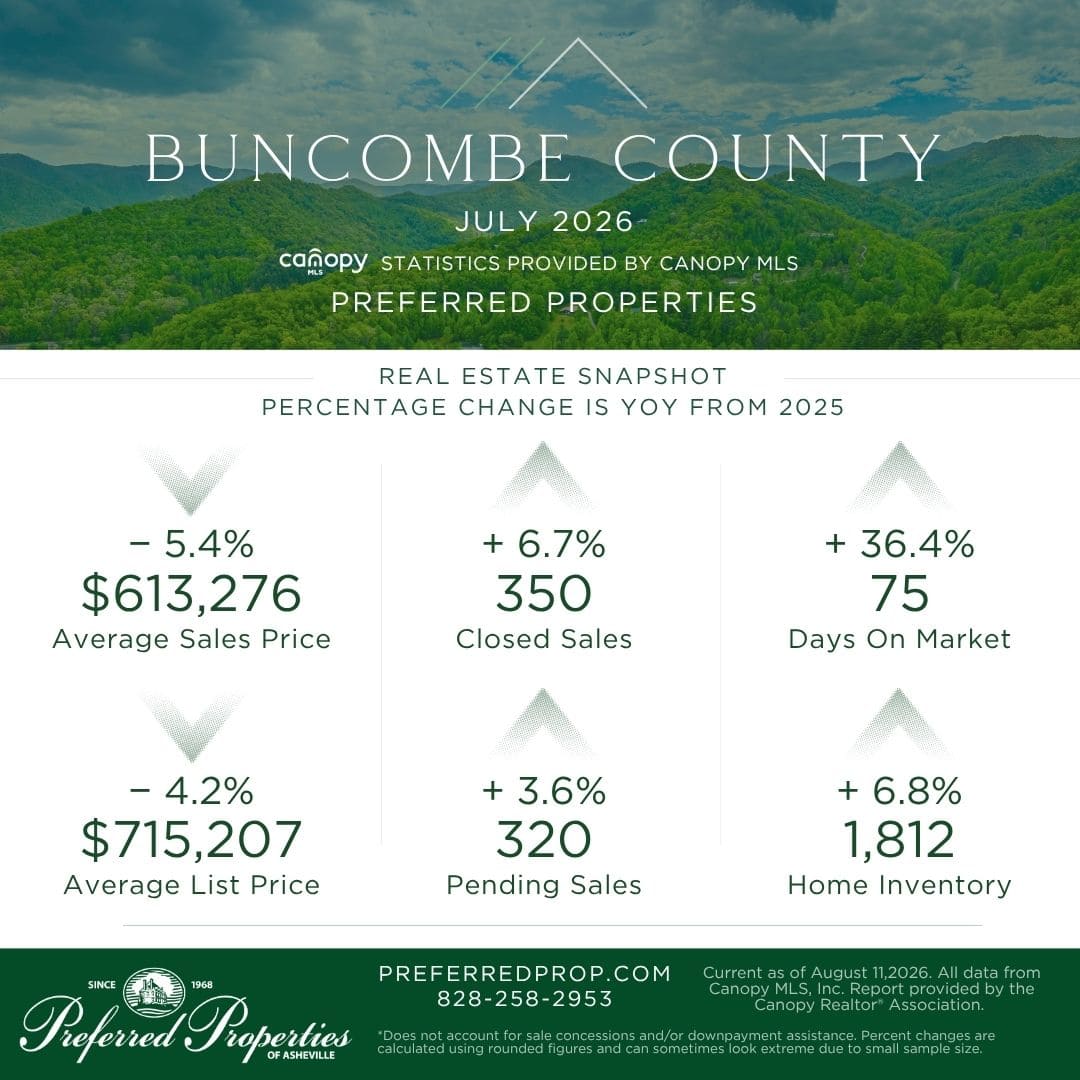
BUNCOMBE COUNTY — July 2026
Pending Sales: 320 | +3.6%
Closed Sales: 350 | +6.7%
Average Sales Price: $613,276 | −5.4%
Cumulative Days on Market Until Sale: 75 days | +36.4%
Average List Price: $715,207 | −4.2%
Inventory of Homes for Sale: 1,812 | +6.8%
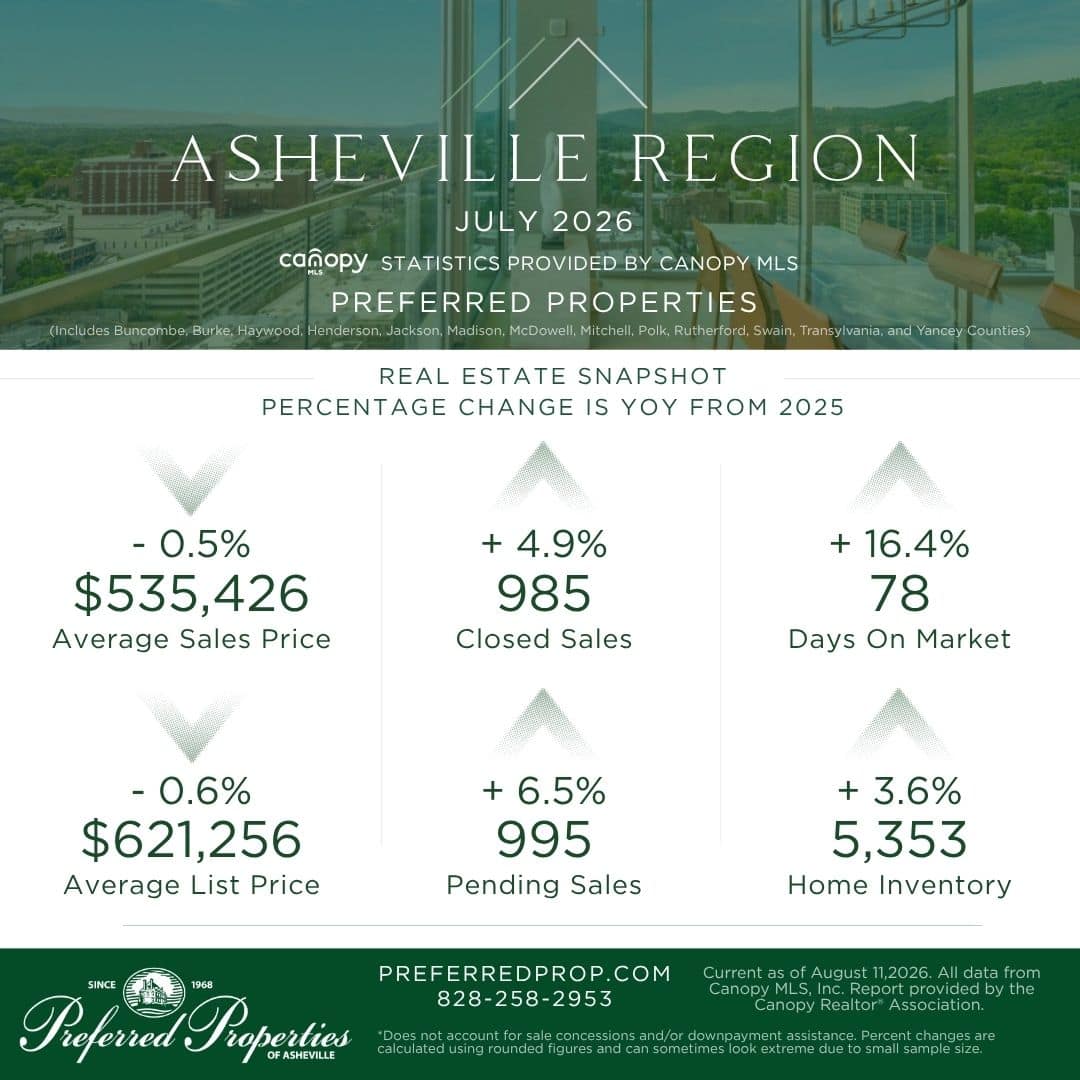
ASHEVILLE REGION - July 2026
Includes Buncombe, Burke, Haywood, Henderson, Jackson, Madison, McDowell, Mitchell, Polk & Rutherford Counties.
Pending Sales: 995 | +6.5%
Closed Sales: 985 | +4.9%
Average Sales Price: $535,426 | −0.5%
Cumulative Days on Market Until Sale: 78 days | +16.4%
Average List Price: $621,256 | −0.6%
Inventory of Homes for Sale: 5,353 | +3.6%
828-258-2953
https://www.preferredprop.com
#AshevilleRealEstate #AshevilleNC #AshevilleHousingMarket #RealEstateMarket #AshevilleHomes #WesternNorthCarolina #HousingMarket
📍1 Cedar Chine Drive, Asheville
MLS#4393411
6 Bedrooms, 5/1 Baths
6,000 SqFt.
1.27 Acres
A Craftsman Masterpiece in Biltmore Forest. Tucked within the tree-canopied streets of the Town of Biltmore Forest, this exceptional, refined mountain- contemporary home offers a rare blend of timeless elegance and modern livability. Echoing the architectural spirit of nearby Biltmore Village, the residence was completely re imagined by Robert Griffin Architects in 2021. Set on over an acre, the property welcomes you with a gorgeous covered front porch, perfect for savoring the changing seasons of the Blue Ridge Mountains. Inside, rich wood details flow throughout, creating a seamless connection between the home’s warm interiors and the natural beauty of Western North Carolina. The main level is anchored by a true chef’s kitchen and a luxurious primary suite, offering effortless one-level living. Upstairs, four spacious bedrooms provide comfortable accommodations for family and guests alike. The lower level is designed for both relaxation and gathering, featuring an additional bedroom, recreation room, office area, sauna, fireplace, space for your home gym and abundant storage. Outside, the expansive, level yard offers room to play, a charming fire pit for evening gatherings. This beautiful stretch of neighborhood is perfect for strolls connecting you to the surrounding community, while this section of Biltmore Forest preserves the privacy the neighborhood is known for. A home of exquisite detail, enduring charm, and quiet mountain living.
Call for a private tour:
Ann Clark 📞828-712-0033
Broker/REALTOR®
Newton Clark 📞828-231-3903
Broker/REALTOR®
www.preferredprop.com
#dreamhome #ashevillerealty #mountainhome #ashevillenc #ashevillenorthcarolina #asheville #ashevillrealestateagent #listingagent #buyeragent #newlisting #newlistingalert
Our agents Tracy Dew and Jim Reid have Open Houses this weekend.
.jpg)
SATURDAY OPEN HOUSE
1-3 PM
📍162 Deaver Street, Asheville NC
MLS#4345314
3 Bedrooms, 2/1 Baths
2,168 SqFt.
Finished Basement
🏡With a Walk Score of 74, this 3-bedroom, 2.5-bath home with a fully finished basement offers easy access to the best of West Asheville — just five minutes to Taco Billy, Pizza Mind, and Hole Doughnuts, with quick connections to the Wilma Dykeman Greenway and the River Arts District.
Tracy Dew
Broker/REALTOR®
📞828-423-5700
tracy@preferredprop.com
.jpg)
SUNDAY OPEN HOUSE
1-3 PM
📍5 Hoolet Court, Biltmore Lake
🏡Located on a quiet cul-de-sac in sought-after Biltmore Lake, this one-level home offers comfortable living just 15 minutes from downtown Asheville.
MLS#4372678
0.51 Acres
3 Bedrooms, 2 Baths
Tracy Dew
Broker/REALTOR®
📞828-423-5700
tracy@preferredprop.com
www.preferredprop.com
Preferred Properties of Asheville
.jpg)
SUNDAY OPEN HOUSE
2-4 PM
🏠47 Deerwood Drive, Asheville
MLS#4361214
3 Bedrooms, 2 Baths
1,620 SqFt.
0.37 Acres
Find your ideal home in East Asheville, located less than 5 miles from Downtown. The home has been wonderfully updated and refreshed to enhance today’s life style, while preserving its mid-century attributes.
Jim Reid
📞828-606-0590
jimreid@preferredprop.com
Preferred Properties of Asheville
#openhouse #openhousesunday #openhousesaturday
#Asheville #RanchHomes #AshevilleNC #ParkwayKnolls #HomesinAsheville #ListingAgent #PreferredProperties #EastAsheville #biltmorelake #lakeliving #luxuryhome
📊 May 2026 Housing Market Snapshot🏡
Provided by Preferred Properties of Asheville & Canopy MLS
📍Asheville Region
Pending Sales: 1,068 ⬆️+ 18.7%
Closed Sales: 871 ⬆️+ 1.5%
Average Sales Price: $518,836 ⬆️+ 1.9%
Days on Market Until Sale: 83 ⬆️+ 36.1%
Average List Price: $689,521 ⬆️+ 12.6%
Inventory of Homes for Sale: 4,975 ⬆️+ 5.7%

📍City of Asheville
Pending Sales: 215 ⬆️+ 28.7%
Closed Sales: 165 ⬆️+ 4.4%
Average Sales Price: $631,959 ⬆️+ 2.5%
Days on Market Until Sale: 79 ⬆️+ 49.1%
Average List Price: $785,290 + 15.6%
Inventory of Homes for Sale: 868 ⬆️+ 0.7%

📍Buncombe County
Pending Sales: 406 ⬆️+ 27.3%
Closed Sales: 296 ⬆️+ 2.8%
Average Sales Price: $656,761 ⬆️+ 6.7%
Days on Market Until Sale: 79 ⬆️+ 61.2%
Average List Price: $785,694 ⬆️+ 17.4%
Inventory of Homes for Sale: 1,663 ⬆️+ 5.1%

🔗 Learn more at www.preferredprop.com
📞 828-258-2953 Speak to an agent on duty.
#AshevilleRealEstate #MarketStats #HousingUpdate #BuncombeCountyHomes #AshevilleLiving #PreferredProperties #WesternNCRealEstate #RealEstateTrends
PRICE IMPROVEMENT
Set on nearly 50 pristine acres in the foothills of Western North Carolina, this fully re-imagined estate offers a rare blend of refined living and premier equestrian amenities.
 573 & 577 Randolph Road, Marion
MLS#4368362
Offered at $1,550,000
3 Bedrooms, 4 Baths
3,315 SqFt.
48 Acres
Thoughtfully renovated, the property delivers a turnkey lifestyle with privacy, beauty, and modern upgrades. The stately brick home has been extensively updated, including a new roof (2025), windows, flooring, paint, siding, and a striking front entry. Inside, a redesigned kitchen features granite countertops, new appliances, and custom finishes. Spa-inspired bathrooms including a luxury bath with bidet- elevate the home’s comfort. Hardwood floors span the upper level, while luxury LVP enhances the lower level. The lower level provides flexible living space with a media room, full bath, and an additional finished room with closet. Major system improvements include updated electrical and plumbing, a whole-house Aquasana filtration system, and a serviced gas-log fireplace. Outdoor living is highlighted by a newly constructed back deck overlooking manicured grounds and serene natural surroundings. A greenhouse retreat with a Michael Phelps swim spa creates a private wellness escape. Equestrian facilities are equally impressive. The 9 stall barn includes large stalls with automatic watering capability, a remodeled apartment, climate-controlled and updated tack room, wash bay, and hay storage. The property features 12 open acres with two fenced paddocks for rotational grazing, open pastureland, and space for a future riding arena. Enjoy scenic trails throughout the property, along with two creeks, and a natural spring. Two serviced wells, one for the home and one for the barn, both feature new pressure tanks. Additional highlights include RV hookups, a concrete driveway, garage with workshop, and storage building. Conveniently located just 3.5 miles from Lake James State Park, near I-40, and within easy reach of Asheville and Tryon International Equestrian Center. A rare opportunity to own a turnkey luxury equestrian estate where sophistication meets serenity.
https://www.youtube.com/watch?v=TLFSwttFIHc
Listed by
Ann and Newton Clark
828-712-0033
828-231-3903
Preferred Properties of Asheville
PRICE IMPROVEMENT
22 Snap Dragon Court, Asheville
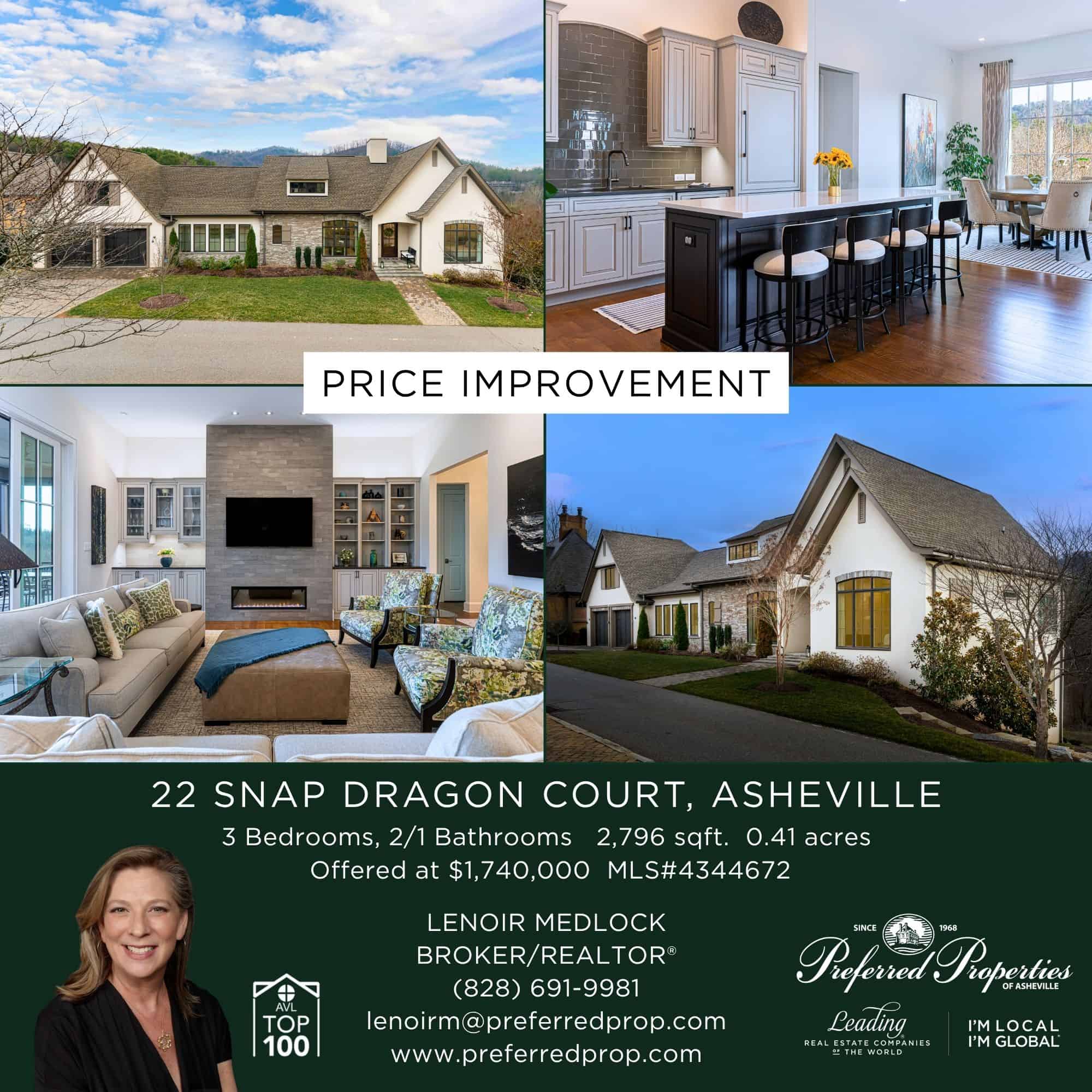
MLS#4344672
Offered at $1,740,000
3 Bedrooms, 2/1 Baths
2,796 SqFt.
0.41 Acre
Contemporary, Custom Built, One-Level Home in Thoms Estate. Built by Asheville's J.S. Miller Construction, this one-level, custom built home is located in North Asheville's gated Thoms Estate. The home features 5-inch white oak flooring throughout, antique brass fixtures, custom cabinetry, and LED art lights. High ceilings and views from nearly every room create an open, airy feel. The living room includes a multi-colored electric fireplace and modern built-ins, with direct access to a large screened porch overlooking the mountains and Beaver Creek. An attached uncovered deck provides additional outdoor space for grilling. The kitchen is equipped with top-of-the-line Thermador appliances, Metro Quartz countertops, and custom cabinet panels. The primary suite offers a large walk-in closet that connects to the laundry room, plus a bathroom with a frameless shower and separate soaking tub. Superior finish qualities throughout. The community provides access to miles of trails, athletic courts, a community garden and an open air pavilion. Architectural plans for the basement incorporation are available and will be released to serious buyers upon request.
https://www.preferredprop.com/.../22-snap-dragon-court.../
LeNoir Medlock
828-691-9981
lenoirm@preferredprop.com
Preferred Properties of Asheville
Congratulations to our May 2026 Peak Performers! 

We’re proud to celebrate the outstanding accomplishments of our top agents:
 Top Producer – LeNoir Medlock, 828-691-9981

Top Listing Agent – Grady Bradshaw, 828-455-9630
.jpg)
Top Buyer Agent – Tracy Dew, 828-423-5700
.jpg)
Preferred Properties of Asheville
 preferredprop.com |
  828-258-2953
#PreferredPropertiesAVL #AshevilleRealEstate #TopAgents #RealEstateExcellence #maypeakperformers #topagents #WNCRealEstate #2026TopProducers #ListingAgent #BuyerAgent


Connect